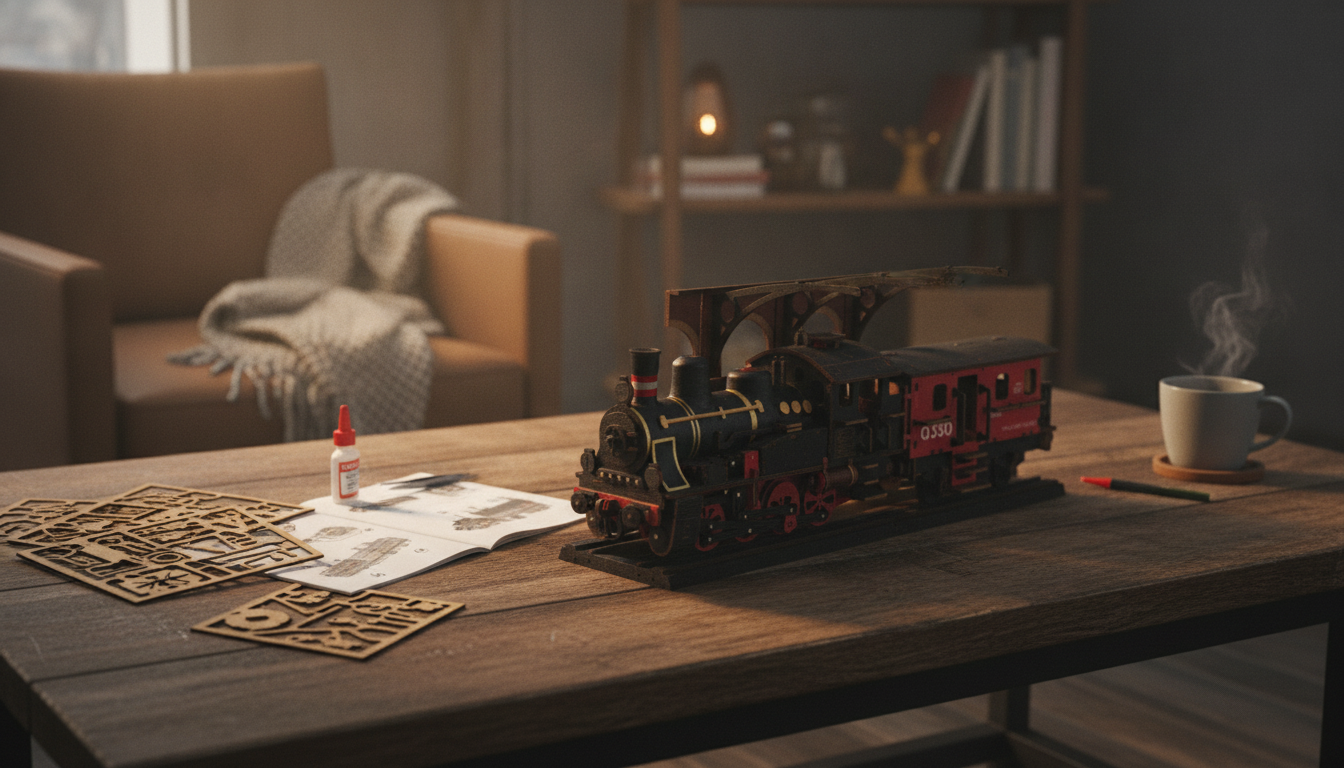
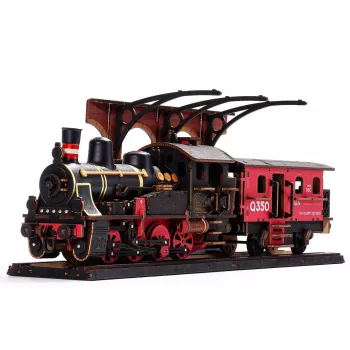
The Steam Journey 3D Wooden Train Puzzle turns the iconic silhouette of a steam locomotive into a hands-on build you can enjoy at your own pace. Instead of a flat jigsaw, this project uses interlocking wooden pieces to create a dimensional train with depth, mechanical-style detailing, and a finished look that feels right at home on a shelf, desk, or hobby display. It’s the kind of screen-free activity that rewards steady focus—part craft, part model-building, and part collectible decor. For more guidance, see California State Railroad Museum.
At its core, Steam Journey is a wooden model kit that assembles into a steam-train-style locomotive with connected cars. The build is designed to be tackled step by step: sort and identify pieces, assemble smaller submodules, and then bring everything together into one cohesive train. For further reading, see Another Step – Mid-Continent Railway Museum.
Once completed, the model works as decor and a conversation piece—especially for hobby rooms, offices, libraries, and shelves where a classic locomotive theme fits naturally. It also makes a project-style gift for builders who prefer tactile activities and the satisfaction of creating something display-worthy from scratch.
If you want to see full product details, you can find the kit here: Steam Journey 3D Wooden Train Puzzle.
Unlike traditional puzzles, 3D construction creates real volume—wheels, body contours, and train proportions that read immediately as a locomotive. That dimensionality is a big part of why the finished piece feels collectible.
Steam Journey uses many smaller parts, which naturally encourages patience and careful alignment. Builders who enjoy incremental progress—finishing a section, checking fit, then moving to the next—often find this style of kit especially relaxing and engaging.
The wood look pairs well with vintage decor, minimalist shelves, and even industrial-style spaces. It’s a warm, neutral visual that doesn’t clash with most home office or living room setups.
Steam locomotives have a built-in “classic” factor. They’re instantly recognizable, and the history behind them makes them fun to talk about—whether that’s early American rail milestones (see Smithsonian Magazine’s overview of the first American steam locomotive) or the fundamentals of steam power (read Britannica’s explanation of the steam engine).
Steam Journey sits in a mid-range price tier for a display-grade wooden model kit and is currently available. It’s a good fit for hobby builders, adults who enjoy model assembly, and older kids with supervision. For a smoother experience, it pairs nicely with a small tool set—think tweezers, a sanding stick, and a dedicated work surface so small pieces don’t get lost.
| Item | Details |
|---|---|
| Product | Steam Journey 3D Wooden Train Puzzle |
| Price | 44.67 USD |
| Stock status | In stock |
| Product page | https://devicescollection.com/steam-journey-3d-wooden-train-puzzle/ |
This kit suits several types of builders and gift recipients:
Start by laying out the parts, scanning the instruction flow, and organizing pieces by shape or size. A tidy setup makes it much easier to stay confident as the project becomes more detailed.
Most builders find it smoother to complete smaller components first—like the engine body area, wheel/trim segments, and the car sections—before joining them together into the final train. This approach keeps the work manageable and reduces the chance of misalignment.
Press-fit connections can vary slightly from piece to piece. If a joint feels overly tight, gentle sanding can help the fit without stressing the wood. Taking an extra moment here tends to pay off in a cleaner, straighter final look.
Once assembled, give the model a light dust-off and place it on a stable surface. Like most wood items, it’s best kept away from moisture and direct heat sources to help maintain its shape over time.
Yes, it’s approachable because the build follows a step-by-step flow, but it’s best for beginners who can take their time and pay attention to alignment. For younger builders, supervision and a tidy workspace help prevent frustration and lost pieces.
Many wooden model puzzles rely on press-fit parts, so special tools usually aren’t required. Tweezers and a small sanding stick can help with tiny pieces and tight joints, while glue is typically optional if you want extra permanence.
Dust it gently with a soft cloth and keep it in a dry area away from direct heat, humidity, and strong sunlight. Displaying it on a stable surface also helps prevent accidental damage over time.




Leave a comment