
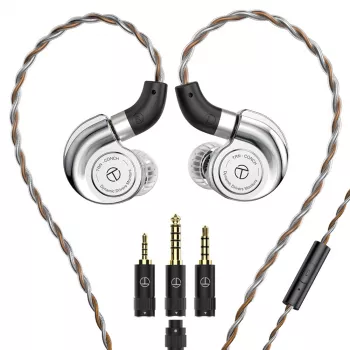
Diamond-diaphragm in-ear monitors (IEMs) pair a stiff, low-distortion driver material with user-adjustable tuning filters, so the sound can be shifted without apps or heavy EQ. That combination can be especially useful for everyday listening where conditions change—quiet rooms, noisy commutes, gaming sessions, or casual monitoring—because a simple filter swap can tame treble, lift bass, or restore balance when your ears are tired. Below is a practical guide to what the diaphragm material can (and can’t) do, what tuning filters actually change, and how to lock in fit, comfort, and isolation so the IEM performs the way it’s supposed to.
Diaphragm stiffness and mass affect how a driver behaves at higher frequencies and during fast transients. A stiffer diaphragm can resist “breakup” (unwanted flexing modes) as frequency rises, which helps preserve detail and reduce harsh resonances when the driver is pushed. When rigidity is paired with low mass, attacks on drums, plucked strings, and consonants in vocals often sound cleaner and more defined.
It’s also worth separating marketing from materials science. Many “diamond” IEMs use diamond-like carbon (DLC) coatings rather than pure diamond. DLC can still be a high-performance coating, but the end result depends on the entire driver system: magnet strength, voice coil, suspension, damping, and how the acoustic chamber and nozzle are designed. A great diaphragm can be held back by poor acoustics, and a modest diaphragm can sound excellent with strong tuning.
Finally, real-world sound is shaped heavily by the eartip seal and nozzle geometry. If the seal leaks, bass drops and treble can feel too forward—no diaphragm can fix that. Think of the diaphragm as potential; fit and tuning determine whether you actually hear it.
| Diaphragm type | Common strengths | Potential trade-offs | Best for |
|---|---|---|---|
| Diamond/DLC-coated | Fast transients, clear treble extension, controlled distortion | Can sound bright if paired with aggressive tuning; depends heavily on filter/nozzle acoustics | Detail-focused listening, clean vocals, crisp percussion |
| LCP (liquid crystal polymer) | Balanced tonality, good speed, stable behavior | May not feel as “snappy” as stiffer coatings in some tunings | All-round music, mixed genres |
| Beryllium-coated | Very high rigidity and speed, excellent dynamics | Can be pricier; some tunings become sharp without damping | High-energy music, dynamics and punch |
| PET/Mylar | Warm, forgiving sound; cost-effective | Less micro-detail; more breakup at upper treble in some builds | Casual listening, comfort-first tuning |
Tuning filters typically work by modifying airflow, acoustic damping, and nozzle impedance. In plain terms, they alter how pressure moves in and out of the nozzle and how much energy is absorbed on the way to your ear. That can shift bass quantity, bring vocals forward or back, and change treble “edge” and perceived air.
Different IEMs implement filters differently: screw-in nozzles with different meshes, interchangeable nozzle tips, or plug-in dampers. Handle them with clean, dry hands—oils and dust can clog meshes over time, which often shows up as reduced treble or a slight channel imbalance.
Because the ear canal naturally amplifies certain frequencies, small filter changes can feel larger than expected. Compare filters at moderate volume and keep loudness consistent; otherwise the “louder” option can seem clearer even when it’s simply boosted in the upper mids.
If your set uses screw-in filters, avoid overtightening. Cross-threading or crushing an O-ring can cause air leaks (changing bass) or create rattles. Also replace tips periodically; worn tips leak more and can change the sound long before the driver “wears out.” For safe listening habits during long sessions, follow guidance from the World Health Organization and NIOSH.
If the brightest filter feels impressive in the first five minutes, confirm it with longer listening. The best tuning is the one that stays clear and comfortable after an hour—not the one that sounds “most detailed” at a glance. If you’re curious about what DLC actually is, Encyclopaedia Britannica’s overview of diamond-like carbon provides a helpful high-level explanation.
Filters primarily change frequency response by altering damping and airflow, which can also shift perceived detail and soundstage. Heavy damping may reduce treble energy and make the presentation feel smoother, but that’s a tuning choice rather than inherently “lower quality.”
No. The diaphragm material can support fast transients and clean extension, but overall tuning, nozzle acoustics, and your seal dominate what you hear. A warm, relaxed tuning can still use a diamond/DLC diaphragm.
Start with the balanced filter to establish a baseline, then change one step at a time based on what you want to fix: too sharp (treble-smoothing), too thin (bass/warm), or lacking air at low volume (clarity). Keep volume consistent when comparing so loudness doesn’t bias the result.





Leave a comment