Stay Sharp with AI: Deep Work, Focus, and Clarity

Stay Sharp with AI: A Practical Guide to Focus, Deep Work, and Mental Clarity
Constant notifications, open tabs, and mentally heavy to-do lists make sustained focus feel rare. A digital guide built around AI-assisted workflows can help reduce cognitive load, clarify next actions, and protect deep work time—without turning the day into an endless cycle of tools and settings.
What “staying sharp” looks like in a high-distraction day
Focus isn’t about forcing intensity all day. It’s about creating conditions where attention can “lock in” on the right thing, at the right time, with minimal friction.
- Clear priorities: knowing the single most important outcome for the next 60–120 minutes.
- Low friction starts: removing the “where do I begin?” delay that drains momentum.
- Sustained attention: fewer context switches and cleaner task boundaries.
- Mental clarity: less rumination because tasks are captured, sequenced, and scheduled.
- A repeatable shutdown: closing loops so the brain stops rehearsing unfinished work.
Research on task-switching consistently shows that bouncing between tasks carries a cost—attention doesn’t instantly snap back to full power. The APA’s overview on multitasking highlights how switching can undermine performance and focus (APA: Multitasking—Switching costs and attention).
How AI supports focus without becoming another distraction
Used well, AI acts like a “thinking partner” that reduces the mental overhead of planning and clarifying. The key is using it at specific moments—before and after focused work—so it doesn’t interrupt your attention mid-flow.
- Using AI for clarity: summarize messy notes into a single next-step list.
- Reducing decision fatigue: generate a short menu of options, then choose and commit.
- Turning vague goals into tasks: convert outcomes into concrete steps with time estimates.
- Pre-planning deep work: define scope, success criteria, and stopping points before starting.
- Creating guardrails: draft a personal “focus contract” (what to ignore, what to do if stuck).
Common focus problems and AI-friendly fixes
| Focus challenge | What it feels like | AI-assisted approach | Best time to use it |
|---|---|---|---|
| Overwhelm | Too many tasks, no clear first step | Condense tasks into 3 priorities and a short next-action list | Morning planning |
| Procrastination | Avoiding a task because it feels unclear | Break the task into a 10-minute starter step and define “done” | Before a work block |
| Context switching | Jumping between apps/messages | Draft a focus schedule and a single-task checklist | Start of each deep work session |
| Mental fog | Hard to hold the whole problem in mind | Summarize notes, extract assumptions, list open questions | Mid-session reset |
| Perfection loops | Endless tweaking without shipping | Set acceptance criteria and a timebox; generate a “good enough” version | Final 20% of work |
A simple AI-assisted deep work routine (start-to-finish)
A routine works when it’s easy to repeat. This one is built for momentum: a fast start, a protected sprint, and a clean finish.
- Setup (3 minutes): capture everything distracting into a quick list, then park it.
- Define the target (2 minutes): write a single sentence describing the output to complete.
- Create a micro-plan (3 minutes): 3–6 steps, each with a rough time estimate.
- Run a focused sprint (25–50 minutes): one task, one tab set, one output.
- Mid-sprint rescue (2 minutes if stuck): ask for 3 next moves, pick one, continue.
- Review (5 minutes): summarize progress, identify the next obvious step, schedule the follow-up.
- Shutdown (3 minutes): close loops by writing tomorrow’s first action and clearing the workspace.
If you want a deeper framework for protecting high-quality focus time, Cal Newport’s work on deep work is a useful reference point for building distraction-resistant routines (Deep Work: Rules for Focused Success in a Distracted World).
Practical ways to use AI for mental clarity
Mental clarity usually isn’t missing “willpower”—it’s missing structure. When tasks live half in your head, the brain keeps cycling them like open tabs. AI can help convert that noise into a small, stable plan.
Prompts and templates that keep work moving (without overthinking)
Healthy boundaries: avoiding dependence and protecting deep work
Who benefits most from a focus-boosting digital guide
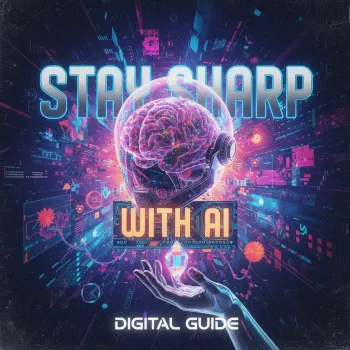
Stay Sharp with AI: what the digital guide helps organize
If a lightweight structure would help you start faster, stay with a task longer, and end the day with fewer open loops, Stay Sharp with AI | Focus-Boosting Digital Guide is designed to keep attention on the work itself—while AI handles the “mental admin” around it.
Helpful add-ons for a calmer, more consistent routine
- Embroidery Daisy Pencil Case Large Capacity School Supplies Pouch for keeping essential study/work tools in one place (less desk friction, fewer micro-distractions).
- Rechargeable Sonic Electric Toothbrush with USB Charging & Replacement Heads to support a simple morning/evening routine that “bookends” workdays and reinforces shutdown habits.
FAQ
Can AI actually help with focus, or does it add more distractions?
AI helps most when it’s used at specific moments—planning before a work block and reviewing after—rather than as a constant companion. Pair it with timeboxing, single-tasking, and notification limits so it reduces decisions instead of creating more.
What’s a good first step for using AI to improve deep work?
Start with a short pre-session plan: define the outcome in one sentence, generate 3–6 steps, choose a 25–50 minute sprint, and set a stop condition. Then run the sprint without checking messages or switching tasks.
How can AI support mental clarity when the day feels overwhelming?
Do a quick brain dump of everything pulling at your attention, then have AI cluster items into priorities and produce a short next-action list. Schedule the remaining items so they stop living as background worry.






Leave a comment